
« Older Entries Subscribe to Latest Posts

31 Jan 2012

Namibia: An Ecotourism Success Story

Posted by TravelBoecker. No Comments

TravelBoecker Adventures carefully selects our African travel suppliers, based on their track record for excellent, reliable service and sustainability. Here is a report on one of our partners in Namibia – published by TIES (The International Ecotourism Society) on January 09,2012 and written by Hans Tammemagi:

The Land Rover bumped along a riverbed, passing scraggly trees and splashing through occasional pools that soon would be dry. I was on a safari tour in the Damaraland region of Namibia in southwest Africa. Since leaving camp, we had passed through a parched, barren, rocky landscape. But the wildlife was like Alice in Wonderland.

Namibia An Ecotourism Success Story

Photo by Hans Tammemagi

A row of oryx trotted along a ridge, baboons scampered on a cliffside, orange and green parakeets squawked in a bush. We turned a corner and, suddenly, four elephants were coming right at us, massive, immense, powerful. Luckily, the elephants ambled ponderously past, ignoring us. This was more than just an African game experience. This was a very successful ecotourism operation in which the local natives are partners.

Later, we visited Fonteine, one of twenty villages in the region. A dozen ramshackle one-story houses were clustered together. Seven families lived here, much as people lived thousands of years ago. They had dogs to ward off cheetahs, goats for food and milk and donkeys and horses for travel. Hidden in this scene, however, is a heart-warming story.

During the early 1980s there was a major drought throughout northwest Namibia. With an abundance of weak livestock, predation by lions increased, causing farmers to shoot them. At the same time, poaching for ivory, rhino horn and meat became rampant. Game numbers declined drastically. And the drought deepened.

Finally, action was taken and wardens were hired to monitor game and resist poaching. Another blessing was the return of rain. By the early 1990s the drought had broken and game was recovering. In the mid-1990s, studies indicated a luxury lodge would draw tourists and benefit the region. In the late 1990s a southern African tourism company was chosen to develop Damaraland Camp — where I was staying.

[Our local touring partner ...] is unusual in today’s corporate world: it has the goals of conserving nature and helping local communities. Thus, it built an elegant lodge and ten permanent tents with a small ecofootprint using local construction materials, solar panels, etc. It pays the community for use of the land, hires local people for the lodge and trains them to managerial levels. Most importantly, the ownership and management of Damaraland Camp is shared with the local people, who inject their own distinctive character and cheerful nature. Total ownership will be transferred to the region over 20 years.

The combination of luxury lodge and big-game safaris has been successful at drawing tourists. Wildlife has more than doubled because villagers have become partners in the ecotourism venture and now value and protect their habitat. Best of all, the lodge creates jobs, encourages education and brings funding into the community. Young locals, who previously would have been goat herders, now can pursue jobs and careers in the hospitality industry.

[They] have taken this model to numerous other camps and regions in southern Africa…

Click here to visit this intriguing country with its many facets and peace-loving population and contact Christine TravelBoecker for first-hand Namibia experience.

4 Nov 2011

Sossusvlei, Namibia… Highest Dunes EVER!

Posted by TravelBoecker. No Comments

Our client, Judith M. recently returned from her Namibian Adventure with these stunning photos. Thank you for sharing!

A Day in the Garden of Eden


Christine Boecker

Authorized Neufeld Course Facilitator

Ph:604.338.9211

28 Oct 2011

Northwest Passage – Off the beaten Track!

Posted by TravelBoecker. No Comments

For centuries explorers sought the Northwest Passage–they just didn’t have the right boat. An Arctic journey, in style.

Anchored at the head of Jakobshavn Fjord off the west coast of Greenland, the MS Hanseatic is practically bow-to-berg with the four-story facade of the Jakobshavn Glacier. This region is one of the Arctic’s great iceberg nurseries. Here, massive blocks calve off the glacier face with a rifle-crack, detonate soaring rooster tails of spray, then bob around until nudged by wind and current down-fjord and out into Baffin Bay, bound for who knows where.

Jacobshaven, Greenland

We are on the first leg of a 24-day voyage from Kangerlussuaq, Greenland, to Nome, Alaska (that’s 4,000 nautical miles and seven time zones’ worth). The Hanseatic is retracing the Northwest Passage, the trans-Arctic sea route that was the grail quest of explorers from the 17th to the 19th century. They were looking for fortune–a commercial shortcut to Asia–whereas we are after polar bears, icebergs, and bragging rights.

The Hanseatic is the only five-star expedition cruise ship plying this route, and will be, at the end of our voyage, only the 139th vessel to have sailed the Northwest Passage in the past decade. The passengers are mostly German (the ship belongs to Hapag-Lloyd, Germany’s premier passenger line), but this cruise usually draws a clutch of English speakers. Everyone aboard is a cruise veteran, with a good yarn or two, but Malcolm George, a semiprofessional jazz musician from London who once tried to woo whales in the Antarctic from a Zodiac by playing the clarinet, gets my Oscar.

On Devon Island we walk a landscape that NASA uses to test vehicles bound for Mars. We see five polar bears during the cruise, notably a mother and cub hopscotching ice floes in the Bellot Strait, and the occasional whale and walrus. We never tire of crowding the bridge to observe Captain Thilo Natke thread the pack ice: “The technique is not to ram the ice but to use the space between the floes.” (The Hanseatic‘s reinforced bow allows it to give them a slap, too.)

Anchored overnight in Cambridge Bay, we shiver while watching the northern lights slither across the sky at 1 a.m., and one morning on Beechey Island we feel chills of compassion as Captain Natke pays homage to 19th-century passage-seeker Captain John Franklin. We are standing on a barren berm of stones, the site of Franklin’s last known encampment–canned food tins from the expedition still litter the ground. Franklin and his party left here in the spring of 1846 and were never heard from again. (In the frenzied search that followed, the British navy lost more ships than it did at Trafalgar.)

Franklin Expedition Grave

But it’s the bleak majesty north of 66 degrees, 33 minutes, 44 seconds, a.k.a. the Arctic Circle, that provides our daily ration of wonder. Sailing down Sondre Stromfjord the first night, we pass battlements of three-billion-year-old, cadaver-gray gneiss, the world’s oldest rocks. On a perfect late-August morning–the thermometer at 52 degrees and the sky a wash of bleached-denim blue–Captain Natke shoehorns the ship into Jesse Bay on Banks Island, and we run the Zodiacs beneath a natural arc de triomphe of red rock. A few days later we go to bed under a blue sky tattooed with finely combed cirrus clouds, and awake in an Ancient Mariner realm of silvery fog and forbidding floes. Two days out from disembarkation in Nome, we cruise along the Smoking Hills, so named by Franklin because the oil shale deposits within them have been on fire for centuries. For some 25 miles this coastal palisade is barred with plumes of smoke, and the cliff face is both wildly colored (like the paint pots in Yellowstone) and charred jet-black from the heat.

The cruise is also a primer on global warming. “Ice isn’t an impediment to life in the Arctic,” says one of our lecturers, Susan Adie. “It makes life possible.” But to the captain, a veteran of the Arctic, it’s clear that there’s a lot less of it. “In 1994 we spent days in dense pack ice in Peel Sound,” Captain Natke tells me, referring to the strait between Somerset and Prince of Wales islands that is open water when we traverse it. In his farewell speech, Natke is even more direct: “Global warming cannot be doubted.”

Service on board the Hanseatic is superb and the food excellent, with plenty of choices for non-German palates. The ship tries to accommodate non-German speakers, too, and announcements are delivered in English, as are some lectures. (But early on, the English speakers on my cruise staged a mini-revolt to increase the number.) The lecturers were by and large stellar, especially Adie. I had only one complaint about the ship (smoking is allowed in the lounges) and one about the itinerary (too many stops at Canadian Arctic towns, which were uniformly dreary).

This year the Hanseatic sails only portions of the Northwest Passage, using the rest of the time to explore the more northerly Arctic islands, which should yield more icebergs, more polar bears, more scenic grandeur, and an ever greater feeling of wonder at the immense solitude–in short, the siren song of the Arctic as an aria.  –Gary Walther, ForbesLife Magazine dated May 23, 2011

The MS Hanseatic will cruise the Northwest Passage from August 14–September 8, 2012.  Cabins are $18,580–$38,600.  For more information contact chris@travelboecker.com

12 Sep 2011

Camping – then and now!

Posted by TravelBoecker. No Comments

Times – and tents – have certainly changed!

Camping in Kruger National Park 1968 AD

My first Camping “Safari” in the 60′s… with equipment that was at least 20 years old already:  a heavy white canvas tent (waterproofing and tarps had not been invented), held up by long, heavy wooden poles with lots of rope. There was no groundsheet, and I remember being sooo cold at night -I couldn’t sleep.

Fast forward to the 21st century:


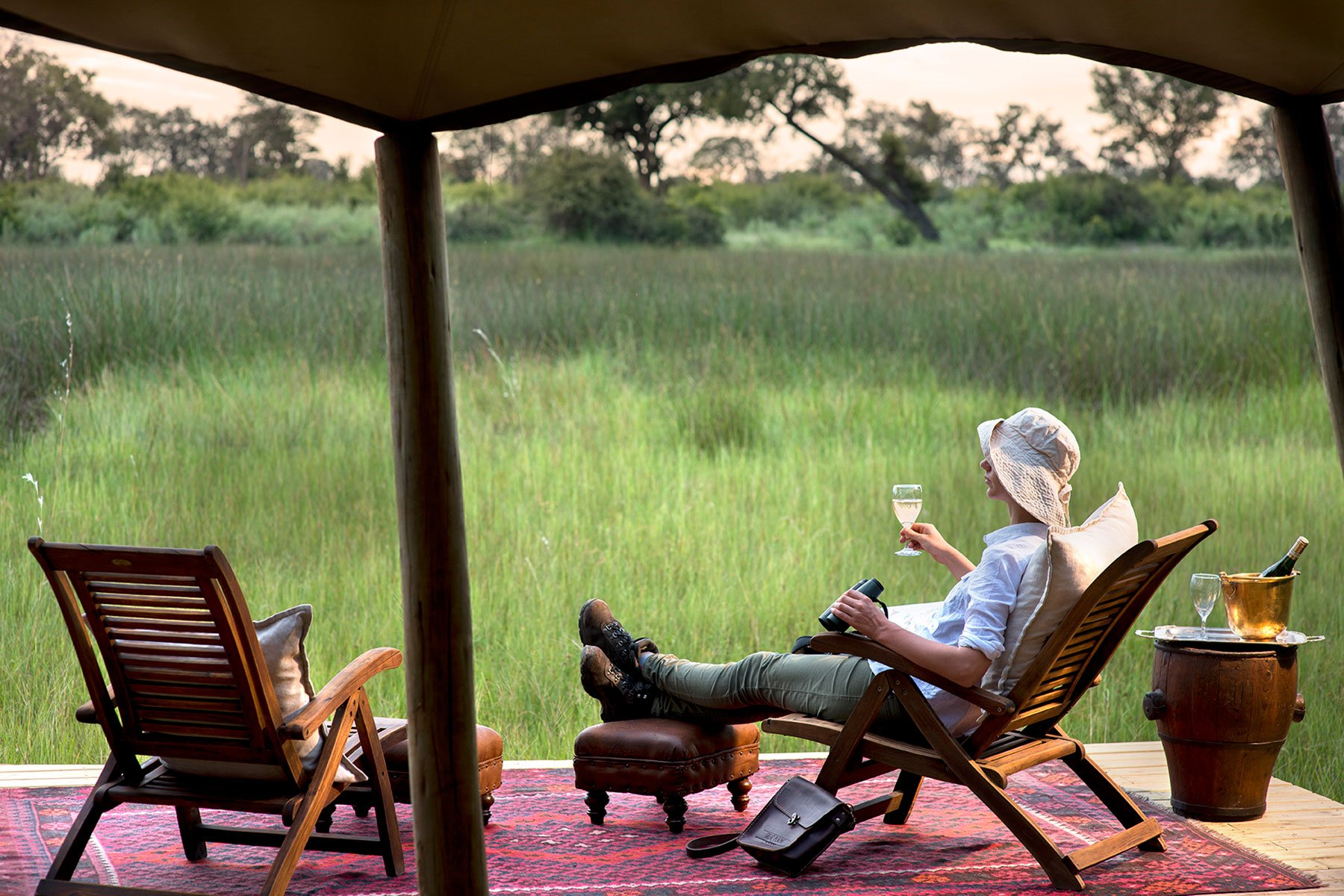
Comfort Camping in Botswana - bathroom en-suite!


Family-friendly camping 2010

On our Botswana Safari in 2010 we thoroughly enjoyed our camping trip under these canvasses!  More here…

11 Sep 2011

BeWILDered about Africa?

Posted by TravelBoecker. No Comments

An Africa Safari is unlike any other journey you will take.  The fascinating mix of culture and wildlife is hard to describe and can only be experienced.  Spot the “Big Five”, dance with the Maasai, camp in the Serengeti, canoe the Zambezi, volunteer on a game farm, cook with the locals… the possibilities are endless.

TravelBoecker Adventures takes the guess-work out of planning your African Safari! We maximize your holiday time, add value, and provide answers to many FAQ’s.  We cover 17 countries and offer dozens of itineraries for trips lasting from 3 to 22 days. And, if you prefer, we’ll skillfully tailor-make your African experience to match your dates and budget.  Choose from Luxury Lodge or Classic Lodge Safaris, participation or fully-catered Camping Safaris, Luxury or Comfort Train Safaris, or even Voluntouring!

Africa Travel Expert, Christine Boecker is from South Africa providing in-depth knowledge of the continent and its people to ensure you enjoy the BEST EXPERIENCE for the BEST VALUE.

On our recent Safari in the Okavango Delta of Botswana – stunning scenery and a paradise for wildlife – we encountered Lions, Elephants, Cheetahs, Hyenas and more – up close and personal! Read more…

Take a virtual tour first… then contact Vancouver Travel Expert Christine Boecker to tailor-make your ultimate Vacation!

10 Jun 2011

Botswana Luxury Safari – for Single Travellers!

Posted by TravelBoecker. 1 Comment

Join our ‘Green Season Safari’  and choose from 9 different luxury camps in Botswana for just $399 a night per person including all game activities, all meals and local brand drinks.

And there’s no single supplement!

Luxury in Botswana has never been more affordable!

The camps and lodges are operated independently, retaining their own individuality and charm, whilst offering guests unique experiences at each location. Camps range in size from 12 to 24 guests and all accommodations are en-suite with all amenities necessary for a comfortable stay.  All properties have a central lounge, dining and bar area and every camp or lodge boasts a swimming pool – one even has a plunge pool on the deck of every suite.

Day and night game drives in several different ecosystems, game cruises on various river systems, mokoro trips, bird watching, Afro botanical walks, fishing and Bushman walks are all included in your stay.

The Ultimate Safari – at affordable prices!

Valid for 01 December 2011 until 31 March 2012.  No single surcharge on accommodation.  Rate does not include flights/transfers between camps.

Contact Chris@TravelBoecker.com for details.

11 May 2011

Africa Travel Talk & Slide Show

Posted by TravelBoecker. No Comments

TravelBoecker & Jet-Lag Travel Fashion Boutique

invite you to join us for a

Free Travel Talk & Slide Show:

Discover Africa – from  Cape to Cairo, and many stops in between!

- Luxury & Classic Wildlife Safaris, Cultural Experiences, Train Journeys, Beach & Hiking Trips, Family & Single Travel & much more -

on

Thursday, May 12th   7 – 9pm

at Jet-Lag Travel Fashion Boutique,  110-12031 2nd Ave,

Steveston Village in Richmond BC.

Light refreshments will be served.

R.S.V.P.  to 604.338.9211 or  chris@travelboecker.com

26 Apr 2011

Game Drives & Wine Tours

Posted by TravelBoecker. 2 Comments

Enjoy the best of South African Luxury on this spectacular 7 day Safari. Discover the beautiful Cape and experience thrilling open vehicle game drives in the gorgeous Sabi Sand Game Reserve.

There are limited spaces available so don’t miss your chance see the best of South Africa with TravelBoecker. Contact chris@travelboecker.com for details.

21 Apr 2011

WIN on Earth Day with TravelBoecker

Posted by TravelBoecker. 2 Comments

To celebrate Earth Day

TravelBoecker is giving away

4 FREE movie passes

for “AFRICAN CATS”

> in theatres on Earth Day.

The movie is filmed on location in Kenya and takes you right into the heart of this great African wilderness!

Click here to enter

The draw will be held on Earth Day, April 22nd!

19 Apr 2011

A Week of Daily Wonders in the Galapagos by SEAN STANLEIGH

Posted by TravelBoecker. No Comments

ECUADOR— From Saturday’s Globe and Mail
Published Friday, Apr. 15, 2011 1:09PM EDT

It started with a conversation over a few pints: “How are we going to celebrate our … birthdays?”… “Let’s take a trip,” I suggested.

After intense negotiations – hiking in Bolivia (too much work), sailing the British Virgin Islands (not enough work), a village trek in Scotland (too many hangovers) – five of us settled on the Galapagos Islands: home of my only travel regret.

Several years earlier, I was in Ecuador for a rain-forest excursion and had plenty of time to explore the site of Charles Darwin’s famous observations, which culminated in the classic On The Origin of Species. Lacking the benefit of hindsight and a comfort level with debt, I declined the opportunity, believing the cost to be extravagant. I have regretted it ever since.

The Galapagos Islands, located 1,000 kilometres west of mainland Ecuador, have a long and rich history. The first recorded discovery was in 1535, and in 1570 the 19 islands earned their name after the thousands of giant tortoises that roamed their shores. The islands were used on and off by sailors and pirates, mostly as a stopover to hunt whales and store tortoises for food, until 1832, when the first formal settlement was established.

Then came Darwin in 1835. His visit would lead to a new theory of evolution, and nearly 200 years later, the site continues to draw scientists and curious onlookers to the home of his greatest triumph. …

I felt like I’d really arrived in the Galapagos on the second day of our weeklong boat cruise. After flying from Quito to San Cristobal island a day earlier, we boarded our 20-passenger ship, the Letty, and took a quick cruise around a dramatic formation called Kicker Rock. But a cancelled swim with sea lions because of stormy seas had dampened our spirits.

Then the events of Day 2 more than made up for the disappointment. We woke up on the shores of Genovesa Island, having travelled overnight. After breakfast, we donned wetsuits and snorkel gear, and plunged into the cool waters, where we swam with an array of tropical fish, coral, colourful starfish and sea urchins. The water was stunningly clear, with new sights everywhere you looked, and our guides, Jeanette and “Pepe” (his nickname was his preference), got their first taste of our reluctance to get back in the dinghies.

We went ashore later that morning and out came the cameras. … Up “Prince Philip’s Steps” we went (he had visited the site in the 1960s). What we saw at the top made my jaw drop: birds. We were practically surrounded. The famous red-footed boobies – yes, I’ve heard them all – and Nazca boobies. It wasn’t just their strange, otherworldly looks that captured my attention, it was the fact they just sat there next to the hiking trails as our group walked by that amazed me.

I’d heard all the stories about the wildlife of the Galapagos, and the complete lack of fear of humans. But it’s one thing to hear about, another to experience. The birds stared intently at us, as though we were the first people they had ever encountered. We were able to crouch next to them, observe them closely, take their pictures, examine their nests, even catch glimpses of their eggs when they stood up to stretch. “This is incredible,” I kept repeating. …

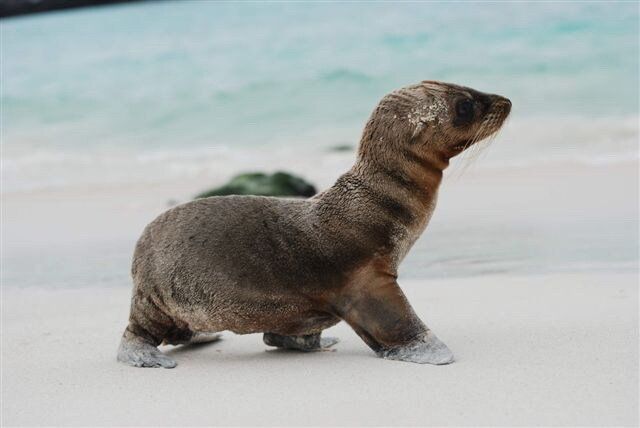
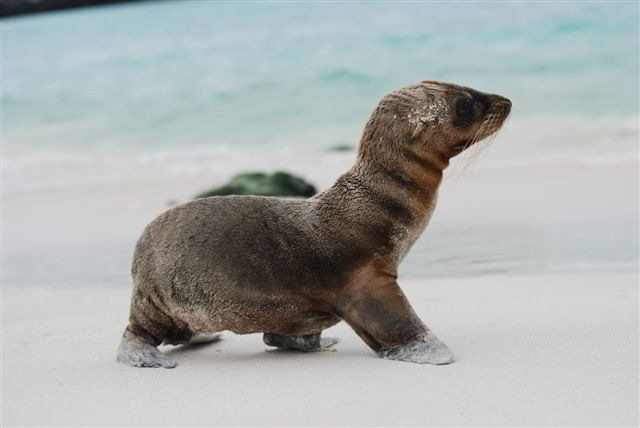
There’s nothing quite like snorkelling in the ocean, watching rays “float” below you, while you’re surrounded by schools of angelfish and parrotfish, when out of nowhere, a sea lion swims toward you and stares you down, face to face mask. …

The most spectacular swim of the trip took place off the shore of Isabela Island on Day 3, when within a one-hour period we saw sea turtles, sea horses, sea lions, bull-headed sharks, chocolate-chip starfish (yellow with black spots) and cormorants and Galapagos penguins taking a dip. To top the day off, as we sailed toward Santiago Island, the sun was setting in spectacular fashion as a school of minke whales broke the surface next to the ship.

It was a week of daily wonders: barren, beautiful landscapes; stunning vistas; naturally formed lava tunnels; blowholes spraying water 15 metres into the air; marine iguanas, often in packs of hundreds, spitting out excess salt; red crabs scampering along rocky shorelines; white-tipped reef sharks; huge marble stingrays and albatrosses performing their mating rituals.

The list seems endless. It was everything I expected from a visit to the Galapagos, and more.”

For more information contact Chris Boecker, Adventure Travel Specialist